
Pearl Harbor and Hiroshima had always been simple in my mind: a tragic provocation to war and a definitive end to that war. Standing in both places, however, forces hard questions. Through this post, you will not find answers. Instead, I hope you will find your own set of questions to ponder on this Memorial Day.
Pearl Harbor
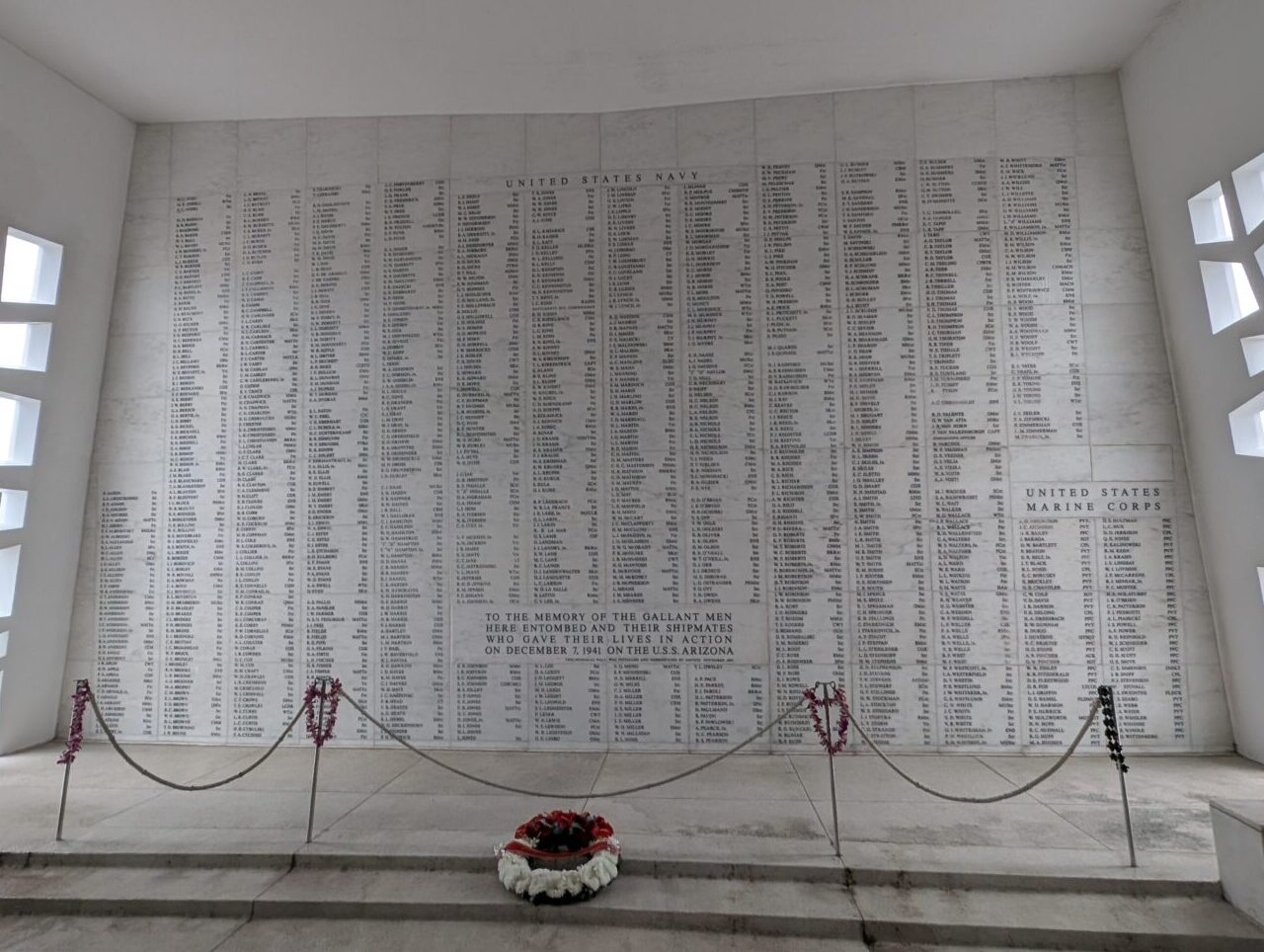
Our worldschooling family visited Pearl Harbor first. There were 2,403 killed in just a few hours through that surprise attack. It was so effective that 49% of the deaths were because soldiers didn’t have time to get out of the sinking USS Arizona.
Standing above that submerged grave was truly harrowing. I became emotional hearing that many survivors chose to be buried there with their fallen brothers.
Provocation
But was Pearl Harbor truly unprovoked? Japan had grown tired of American restrictions on resources like oil. As an island nation, Japan’s access to resources was an existential matter.
Then, why was the US blocking resources? Well, because the Japanese were aggressively expanding their empire. Many Japanese believed conflict in the Pacific was inevitable, and that they needed to act preemptively to ensure their national interests were protected.
Taking over other countries still makes Japan the “bad guy”, right? In many ways, yes. Their military committed horrific atrocities across Asia that must not be minimized. But keep in mind, at the time more than one-third of the world’s population lived under colonial rule. Those lines on the map of Africa had nothing to do with Africans – they were the lines colonizers drew of which territories they controlled. And the US has had its own aggressions: Texas Annexation (1845), the Mexican-American War (1848), and the displacement of Native Americans. It is not as simple as “good guys” vs. “bad guys”.
Hiroshima
Fast forward to 1945. Japan is clearly losing the war but not surrendering. The Soviet Union was preparing to move in from the mainland, while American bombers — like those flown by my grandfather — were routinely devastating Japanese cities. In a culture where sacrifice, honor, and loyalty to the emperor had been woven deeply into national identity, many leaders still believed surrender was intolerable. Was the end in sight, or would they fight to the last man?
Then there was Hiroshima & Nagasaki.
Visiting Hiroshima was very different from Pearl Harbor. It felt far more like a combination of Auschwitz — the mass killing of innocents — and Toul Sleng in Cambodia, where human suffering became almost impossible to comprehend at an individual level. While Pearl Harbor’s attack included only a small percentage of civilian casualties, fewer than 10% of Hiroshima’s approximately 140,000 deaths were military personnel. The overwhelming majority were ordinary people like you and me.
These were school children brought in by the busload to help clear firebreaks between buildings. Mothers carrying infants. Grandparents walking to market. In a single flash, many were burned instantly beyond recognition; others wandered the streets with skin hanging from their bodies, dying slowly over hours, days, or months from injuries and radiation no one yet understood.
And here we were, a family of Americans, walking through this devastating memory right next to Japanese students. My grandparents did this to their grandparents. That takes some swallowing.
And yet, I didn’t feel any stares of judgement or animosity.
The museum here went on to explain the proliferation of nuclear weapons – dozens to hundreds of times more powerful than what hit Hiroshima. At one point, over 60,000 of them existed, mostly in the hands of a few countries.
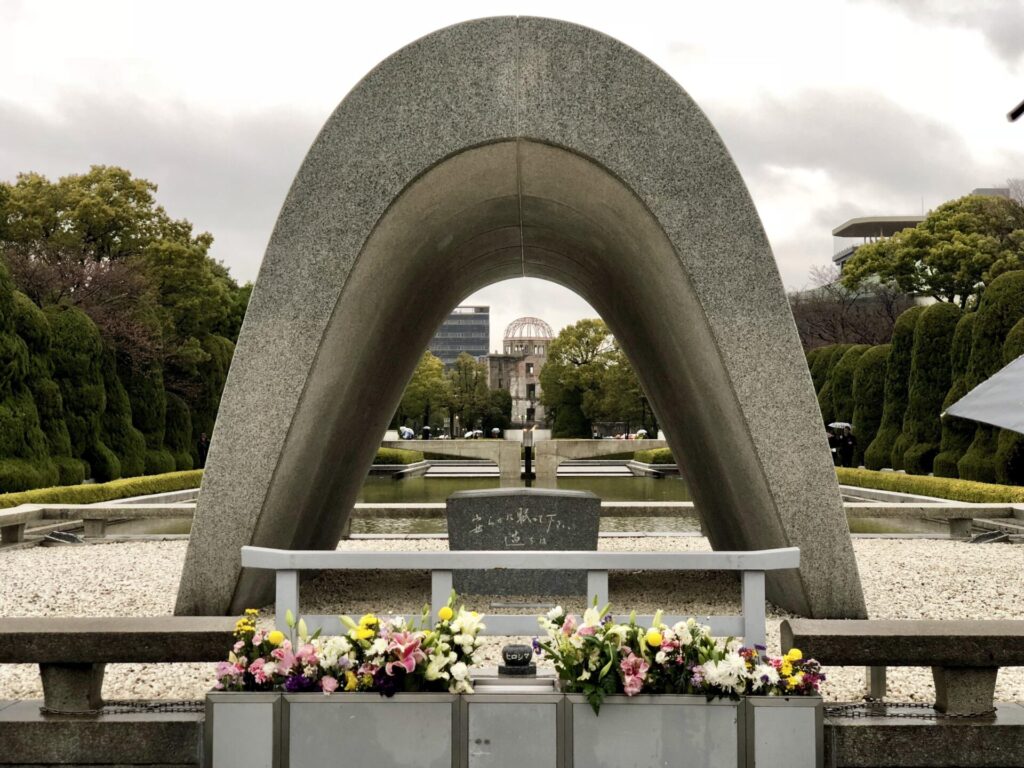
At the center of the memorial burns the Eternal Flame, lit in 1964 with a commitment that it would remain burning until the last nuclear weapon on earth is destroyed. Fire is active, unlike stone ruins. It suggests that remembrance requires ongoing effort, not just preservation.
The flame is best viewed through the arch of the cenotaph, where names of victims are inscribed. And beyond the flame in the background stands the Atomic Bomb Dome. Together:
- The dome anchors you in what happened.
- The cenotaph personalizes the loss.
- The flame projects responsibility forward.
Memory → Mourning → Obligation.
Application Today
After the war, a phrase emerged in Japan: ichioku sōzange — ‘the collective repentance of one hundred million people.’ Japan had come face to face with the consequences of a nationalism that had slowly hardened into superiority, militarism, and unquestioning loyalty to a deified emperor. Success after success had reinforced the belief that Japan was destined to lead Asia and incapable of defeat.
It strikes me how familiar that pattern feels. Nations rarely drift into extremism overnight. More often, people gradually absorb the comforting idea that their side is more righteous, more civilized, more deserving, or more threatened than everyone else.
What should we learn from all this?
Perhaps the hardest question is who gets to define right and wrong in these conflicts. From the comfort of relative peace and hindsight, moral judgment often feels obvious. But history becomes more complicated when nations believe intervention is necessary to stop suffering, while others see that same intervention as imperialism or aggression. Some conflicts seem to demand action; others remind us how easily violence escalates once people become convinced their side alone is “right”. And when generations inherit centuries of fear, trauma, humiliation, and grievance, peace becomes far more than a political negotiation.
Dehumanization and Division
We have an Israeli friend we met in Hawaii. He pointed out something very interesting to us. As the war in Israel re-escalated, he talked about how hard it is to believe in peace when the media outlets immediately refer to the other side as “animals”. These labels: animals, savages, terrorists, colonizers, invaders – all are labels that dehumanize people into categories that are easy to hate.
Dividing people is an age-old tactic, yet how easily do you and I play into the same divisions in modern politics? Have you ever, like me, cast a vote based only on political party? Do you find yourself following those who use strong words and show strength instead of valuing compromise? Has it become taboo to talk politics at the dinner table or workplace, limiting your political interactions to the echo chamber that already agrees with you? We all disagree with sensational, politicized news reporting, but would my Instagram algorithm reveal that I in fact give attention to exactly that?
Path to Peace
Standing in places like Pearl Harbor and Hiroshima, it becomes clear that governments rarely become peaceful before people do. Peace begins with the individual practice of listening before judging. President Russell M. Nelson warned that ‘contention is a choice’ and that true disciples must become peacemakers, especially in a world increasingly addicted to outrage and division. President Dallin H. Oaks recently echoed that same invitation to ‘forgo contention’ and use ‘the language and methods of peacemakers.’
Nations do not learn peace first in treaty rooms. They learn it, or fail to learn it, in families, neighborhoods, comment sections, and dinner tables – where we practice either the habits of reconciliation or the reflexes of war.



0 Comments